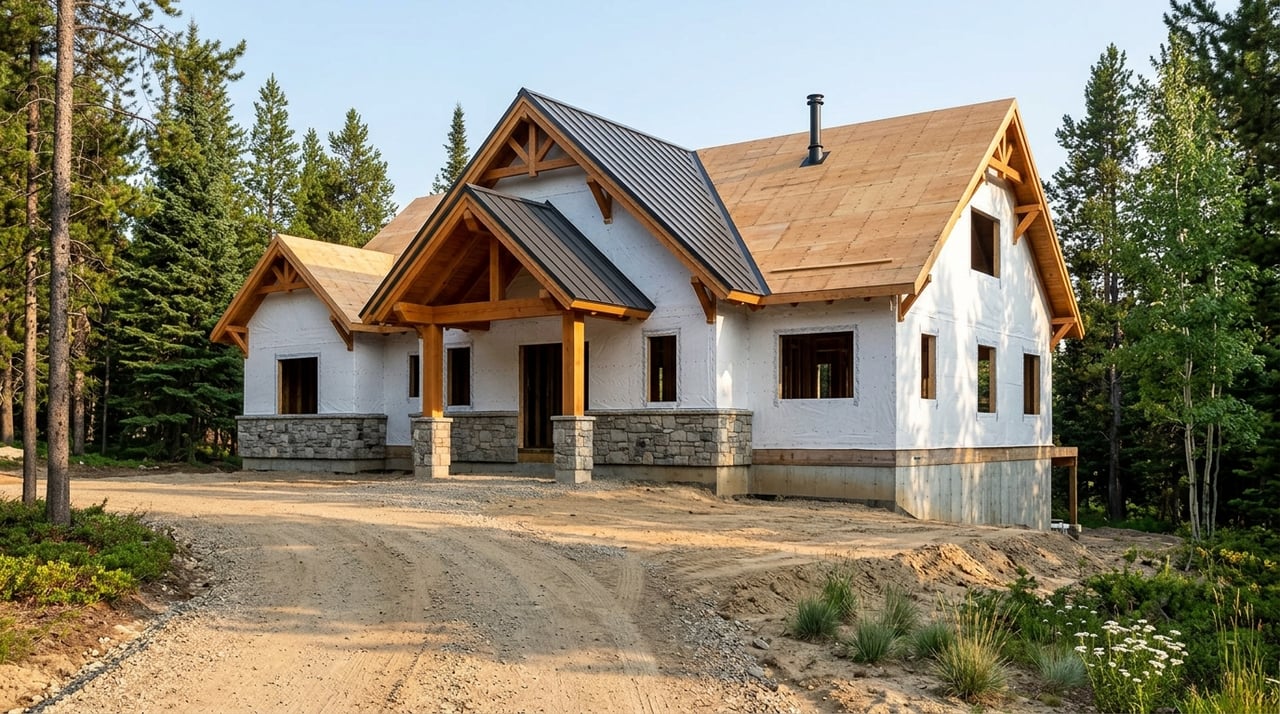
If you are dreaming about a mountain home in Granby, one big question can shape your whole search: should you build from the ground up or buy something that already exists? It is an exciting choice, but it also comes with real tradeoffs around timing, cost, and complexity. The good news is that once you understand how Granby works, the decision gets much clearer. Let’s dive in.
Build vs Buy in Granby
In simple terms, buying an existing home usually offers more speed and certainty, while building offers more control and newness. That is the clearest way to think about the decision in Granby.
But in this market, the answer is not just about your style or budget. It also depends on where the property sits, how water and wastewater are handled, and how much time you are willing to spend coordinating permits and site work.
Granby Location Matters First
Before you compare floor plans or land listings, confirm whether the property is actually inside the Town of Granby or in unincorporated Grand County. Some properties have a Granby mailing address but are outside town limits, and that changes the approval path.
Inside town, permits and planning applications go through the Town of Granby, which uses the 2021 International Building Codes and Cloudpermit. Outside town, Grand County rules and county code amendments apply. That one detail can affect timelines, requirements, and costs from the start.
Why jurisdiction changes the process
If you buy an existing home, much of that groundwork may already be in place. If you build, the right permit office and code path become part of your early due diligence.
This matters even more for vacant land. A lot that looks perfect on paper may come with a very different process depending on whether it falls under town or county oversight.
What Buying an Existing Home Can Offer
For many buyers, resale is the lower-friction path. You can focus on condition, price, and fit rather than building from scratch and coordinating the many steps that come before move-in.
Existing homes also tend to reduce the number of unknowns tied to utilities and approvals. Grand County’s new-home checklist shows that legal water and sanitation must be verified for new construction, and depending on the parcel, the process may also include well, septic or OWTS, driveway, and fire-impact-fee review.
Faster path to move-in
If timing matters, buying is often the simpler option. A standard mortgage closing still has deadlines, but it is usually much more straightforward than a full construction timeline.
For example, lenders must provide the Closing Disclosure at least three business days before closing. That does not make a purchase instant, but it does help illustrate why resale tends to be the better fit when you want a clearer path to ownership.
More budget certainty
Buying an existing home can also make it easier to estimate your all-in cost. You still need inspections and careful review, but you are less likely to uncover a long list of parcel-specific utility and permit expenses after you are already committed.
That can be especially helpful in Granby, where similar-looking properties may have very different infrastructure setups behind the scenes.
What Building a Home Can Offer
If you want a home tailored to your vision, building may still be worth the extra effort. You get more say in layout, finishes, and how the property fits the land.
For some buyers, that level of control is the whole point. If you have been searching and nothing quite matches what you want, building can open up possibilities that resale cannot.
More customization
A custom or semi-custom build gives you the chance to create a home around your priorities. That might mean views, garage space, work-from-home needs, or a floor plan that better fits how you use a mountain property.
This can be especially appealing for second-home buyers and land buyers who are thinking long term. If you are willing to trade speed for personalization, building can be a strong option.
More process to manage
The tradeoff is complexity. In Granby and greater Grand County, new construction is usually more layered than buyers first expect.
Grand County notes that checklist items are only the minimum drawing requirements, and reviewers may ask for more information. In other words, approvals can be iterative rather than one-and-done.
Utilities Can Make or Break a Build
For vacant land, utility questions are often the real story. Before you fall in love with a parcel, you need to know how water and wastewater will be handled.
Grand County verifies legal water and sanitation for new homes. If water comes from a well, the application should be started with the State of Colorado before the building permit is submitted. If sanitation will be handled by an OWTS or septic system, Grand County requires a separate permit, an engineered stamped design, a notarized Declaration of Covenants, and an $850 fee for a new system or complete replacement.
Water service is parcel-dependent
In Granby, water setup is not one-size-fits-all. The town says water tap fees vary by service area, water meters add another $850, and sewer tap fees may be handled by the Granby Sanitation District where applicable.
The town also notes that the homeowner is responsible for the service lines between the main and the house. It also publishes a bulk or construction water rate of $40 per 1,000 gallons.
Similar lots can have different costs
This is where many raw-land decisions become more complicated. Granby states that only the South Service Area has both water and sewer lines maintained by the Town, while other areas use different arrangements and the Granby Sanitation District for wastewater.
So even if two parcels seem similar in price, they may not have similar utility paths. That can affect both your upfront budget and your timeline.
Building Usually Takes Longer Than You Think
Construction is not just about the time spent framing and finishing a house. In Granby, pre-construction work can be a major part of the schedule.
That includes planning applications, utility coordination, water verification, wastewater approvals, and other parcel-specific reviews. If a well is part of the plan, timing can stretch further because Colorado says complete well-permit reviews may take up to 49 days, and a permit is not guaranteed until the application is evaluated.
Construction time is only part of the timeline
A national 2026 benchmark from NAHB found that single-family homes built for sale averaged 6.3 months from start of construction to completion. But that figure covers only the construction phase, not the lead-up work tied to land-use approvals, utilities, and permits.
That is why buyers are often surprised by how long a new build can take from purchase to move-in. In practice, the timeline begins well before the first shovel hits the ground.
Building Costs Often Go Beyond the House
Many buyers focus on the home itself, but a build budget usually reaches much further. Nationally, NAHB estimated that construction costs made up 57.7% of the final price of a new single-family home built for sale, while land acquisition and lot development accounted for 14.1% and government or regulatory costs accounted for 26.4%.
Those are not Granby-specific figures, but they are a useful reminder. When you build, you are paying for far more than walls, windows, and finishes.
Common local cost categories
In Granby, buyers should ask early about:
- Water tap fees
- Water meter charges
- Sewer tap fees where applicable
- Service line responsibility
- Well-related steps if no public water is available
- Septic or OWTS permit and design requirements
- Driveway review
- Fire-impact-fee review
You may not face every item on every parcel. But if you are comparing land to an existing home, these are the kinds of costs that can shift the math quickly.
The Granby Market Has a Wide Price Range
Another reason this decision is not simple is that Granby does not move in one narrow price band. Recent reports show a wide spread depending on property type and reporting window.
Redfin reported a three-month median sale price of $498,202 and 151 median days on market. Grand County’s April 2026 Colorado Association of REALTORS update showed a year-to-date median sales price of $1,065,000 for single-family homes and $630,000 for townhouses and condos.
Why price comparisons need context
These numbers are not directly comparable because they use different timeframes and property mixes. Still, they show something important: your build-versus-buy decision may look very different depending on whether you are comparing land to a condo, a resale single-family home, or a custom mountain property.
That is why local guidance matters. A smart decision in Granby depends on the specific property type, location, and utility setup, not just a headline number.
Questions to Ask Before You Decide
If you are weighing a Granby build against a resale purchase, start with a short list of practical questions.
Questions for any property
- Is the property inside the Town of Granby or in unincorporated Grand County?
- What is your ideal move-in timeline?
- How much budget flexibility do you have for surprises?
- Are you prioritizing customization or convenience?
Questions for land or new construction
- Does the parcel already have legal water and sanitation?
- Will it need a well, septic system, or tap fees?
- Are meter charges, sewer fees, driveway review, or fire-impact fees already known?
- Could any land-use approvals affect when a building permit can be issued?
Grand County notes that in some rural land-use scenarios, building permits may be withheld until required land-use approvals are complete. That makes parcel-level due diligence especially important for land buyers.
So, Should You Build or Buy?
If your top priorities are speed, fewer moving parts, and more predictable costs, buying an existing Granby home is usually the better fit. It often gives you a simpler path to closing and a clearer picture of what ownership will cost from day one.
If your top priorities are control, customization, and creating something new, building may be the right move. Just go in knowing that the process depends heavily on location, water, wastewater, and utility details that can vary from parcel to parcel.
In Granby, the smartest answer is rarely just build or buy. It is understanding the exact property, the exact jurisdiction, and the exact utility path before you decide. If you want help comparing resale homes, vacant land, or mountain properties with more moving parts, Erin Life can help you sort through the options with local perspective and practical guidance.
FAQs
Should you build or buy a home in Granby if you want to move quickly?
- Buying an existing home is usually the faster option because it avoids the full construction, utility, and permit timeline tied to a new build.
What should you check first before building on land in Granby?
- Confirm whether the parcel is inside the Town of Granby or in unincorporated Grand County, because that determines which permit office and code path apply.
What utility issues matter most for a Granby land purchase?
- Legal water and sanitation are key, including whether the lot needs a well, septic or OWTS approval, tap fees, meter charges, or other service-line work.
How long can a well permit take for a Granby-area build?
- Colorado says complete well-permit reviews may take up to 49 days, and the permit is not guaranteed until the application is evaluated.
Why can two Granby lots have very different build costs?
- Utility service areas differ by parcel, and costs can change based on water access, sewer arrangements, tap fees, service lines, and other approval requirements.
Is buying an existing home in Granby always cheaper than building?
- Not always, but buying often comes with fewer unknown costs, while building can add expenses tied to land development, utilities, permits, and regulatory requirements.